
From the moment Aarti Gosine picked up a pencil as a little girl and wrote her first short story, she understood something that many writers take years to discover. Stories can be both an escape and an anchor. They can be magic and memory. They can hold entire worlds while helping us make sense of our own. Her earliest pieces found their way into the Junior Express, the weekly children’s supplement of the Trinidad Express and from that point on she never stopped writing. Not in primary school. Not in her teenage years at Naparima Girls’ High School. Not while pursuing her BSc in Chemistry and Management at the University of the West Indies. Not even while juggling an MBA in Scotland. Writing has always been the quiet, steady heartbeat beneath everything she has accomplished.
Eighteen years ago she stepped into the world of publishing as the Managing Director of JAV Publishing House, a role that has shaped her understanding of the Caribbean literary landscape. Before that she spent seven years at PriceSmart, building a foundation in leadership, structure and discipline that would later support her creative life. But it is her work as an author that continues to define her most. A string of beloved children’s books introduced young readers to magical worlds that felt familiar, filled with adventure, curiosity and the warmth of Caribbean storytelling. The Magic Cave, More Adventures in the Magic Cave, The Jaeden Ring, A Magic Cave Christmas and The Land Below which was shortlisted for the 2022 Bocas Lit Fest Children’s Book Prize have earned her a place in the hearts of parents, teachers and children alike.

Now she steps into a new chapter. A bold one. A tender one. A deeply rooted one. A Place to Call Home is Aarti’s first full-length novel for adults and her first venture into historical fiction. It centres on Sookoo, a beggar from the Dalit caste in Bihar who leaves behind a life marked by poverty, stigma and longing. He boards a ship with nothing but hope and the belief that somewhere on the other side of the world he might finally belong. Trinidad becomes that place. A land that is both promise and hardship. A land that asks everything of him while quietly holding the possibility of becoming home.
The novel is set in 1884, a year etched into Trinidad’s history with pain. While Indian labourers prepared to celebrate Hosay, a ritual of remembrance, community and devotion, the British colonial authorities imposed harsh restrictions. They forbade them from bringing their tadjahs into San Fernando or immersing them in the waters at the wharf, a tradition that connected them to their faith and to each other. What followed was an escalation of tension that erupted into the Hosay Riots at Mon Repos. British troops opened fire on unarmed men, women and children. Many were killed and even more were injured. It remains one of the most tragic chapters in our colonial story, yet one that is rarely told with the emotional depth it deserves.
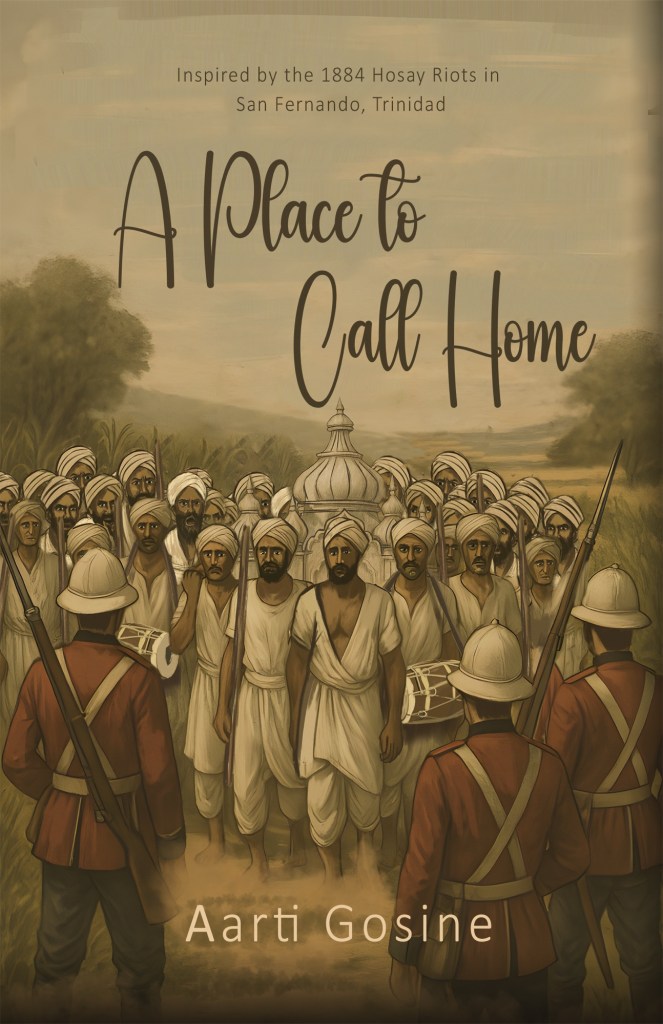
Aarti brings readers into that moment through Sookoo’s eyes. She allows us to feel his fear, his strength, his quiet rebellion and his desperate need to belong to a world that constantly tries to remind him that he does not. Her writing is tender without being sentimental and grounded in historical truth while still giving space to imagination. It is the kind of storytelling that lingers. The kind that makes you pause and reflect on the people who crossed oceans with nothing but their names and their hope for a better tomorrow.
For Aarti, this novel is more than fiction. It is a tribute. A recognition of the lives and sacrifices of Indo Trinidadian ancestors who shaped the culture we know today. It is also a personal exploration of identity. What does it mean to search for home. What does it mean to start over. What does it take to hold on to faith in a world that keeps shifting beneath you.

Sitting with Aarti and hearing her speak about this book, you get a sense of someone who writes with intention. Someone who honours the past while imagining a future where these stories are not forgotten but embraced as part of the collective memory of Trinidad and Tobago. She moves between her roles as author and publisher with a quiet confidence, yet it is clear that this new novel has awakened something deeper. A creative awakening. A sense of purpose. A desire to preserve and protect the stories that form the cultural backbone of our society.
A Place to Call Home is not just a novel. It is a bridge between generations. It is a mirror held up to our history. It is the voice of those who could not tell their stories when they lived them. And it is Aarti’s most ambitious and profound work yet. A reminder that home is often not a place we find but a place we build within ourselves. One choice. One journey. One act of courage at a time.


