
On the eve of the 50th anniversary of our Republic, Oxford added “Trinbagonian” to the historical record of the English language. For me, the timing could hardly have been more meaningful.
I grew up with an enormous hardcover edition of the Oxford English Dictionary in our home. As a child, I would sit with that great book pressed against my legs and peer through its pages searching for random words that would wow me and send my imagination wandering somewhere new. I was never necessarily looking for anything in particular. That was part of the magic. One word could lead to another, one definition could raise another question and suddenly I had travelled somewhere without ever moving from where I sat.
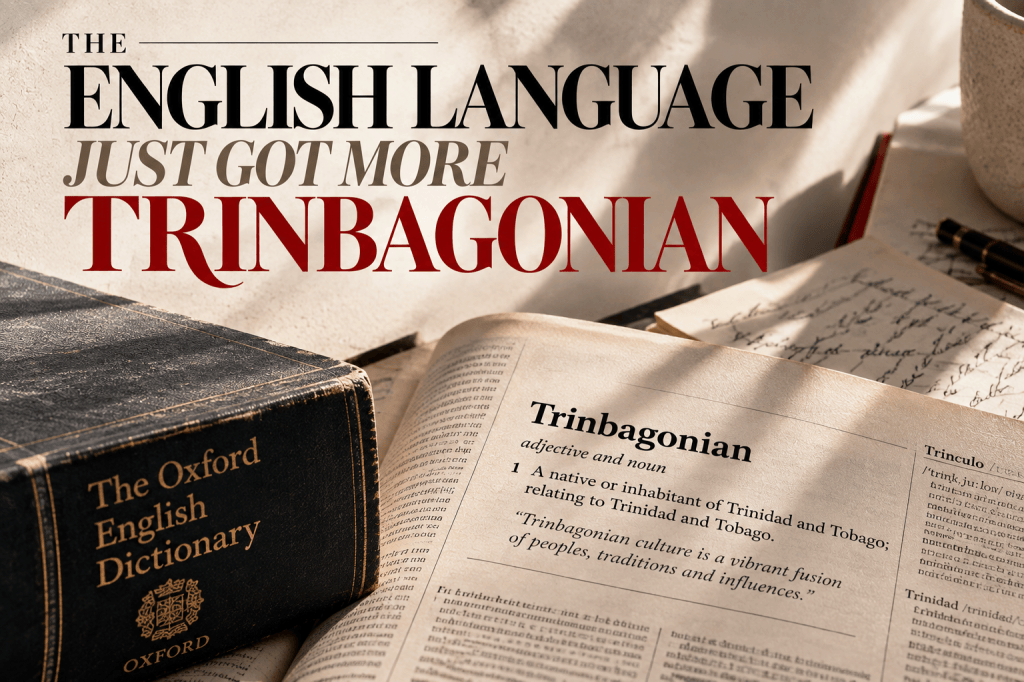
In my childhood memory, that dictionary was bigger than even our family Bible. I remember its weight against my legs, the thin pages and the seemingly impossible number of words contained inside it. Back then I opened Oxford because I wanted its words to show me the world. Yesterday, as Trinidad and Tobago celebrated 50 years of Republic Day, I found myself thinking about that little girl and that enormous book again, because this time some of the words inside it were showing the world something about us.
The timing is extraordinary. On Wednesday, September 23, Oxford University Press announced its September 2026 update to the Oxford English Dictionary, adding more than 400 new words, phrases and senses from around the world. The announcement came one day before Trinidad and Tobago marked the 50th anniversary of Republic Day on September 24, commemorating the first sitting of Parliament under our Republican Constitution in 1976. Trinidad and Tobago actually became a Republic on August 1, 1976, but September 24 became Republic Day because that first Parliament met on that date. (Oxford University Press)
Almost exactly half a century after that moment of national self-definition, one of the world’s great historical dictionaries formally recorded a word we use to define ourselves: Trinbagonian.
There are coincidences that a journalist should resist over-interpreting, and then there are coincidences so beautifully timed that they deserve at least a moment of appreciation. This one stopped me. A Republic is, among many other things, an assertion that a people can define and govern themselves. Fifty years later, on the eve of the anniversary of our first Parliament under the Republican Constitution, there was our own word for ourselves entering another historical record.
Then Oxford added a tiny flourish I could never have written into the story myself. Its Word of the Day on September 24, Republic Day, was Trini, defined as “a native or inhabitant of Trinidad; a Trinidadian”. (Oxford University Press)
If language has a sense of occasion, apparently it was paying attention.
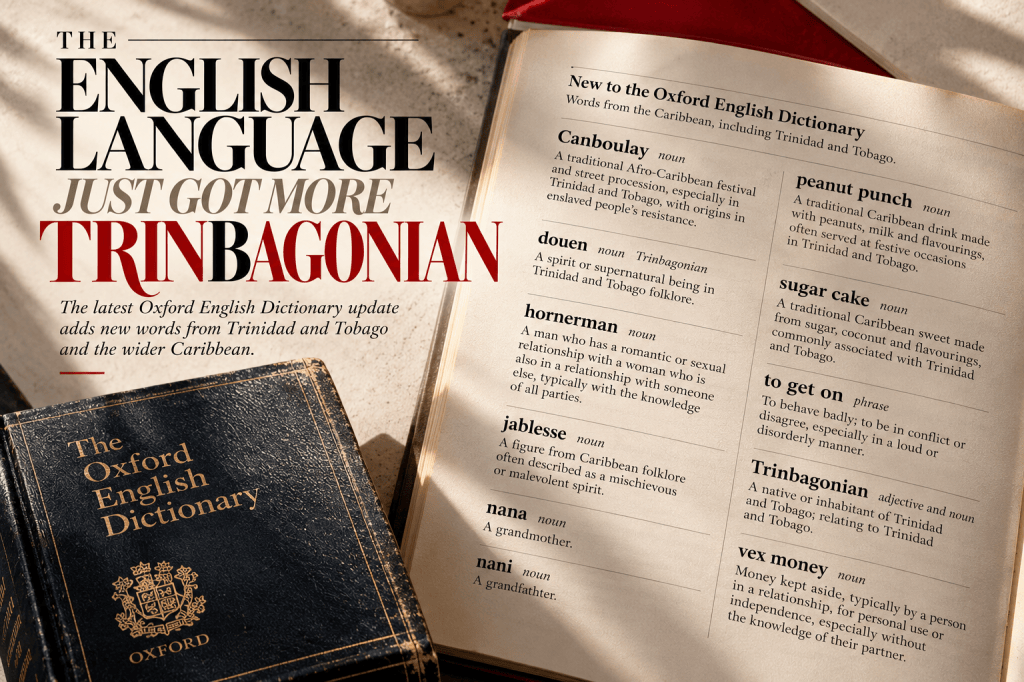
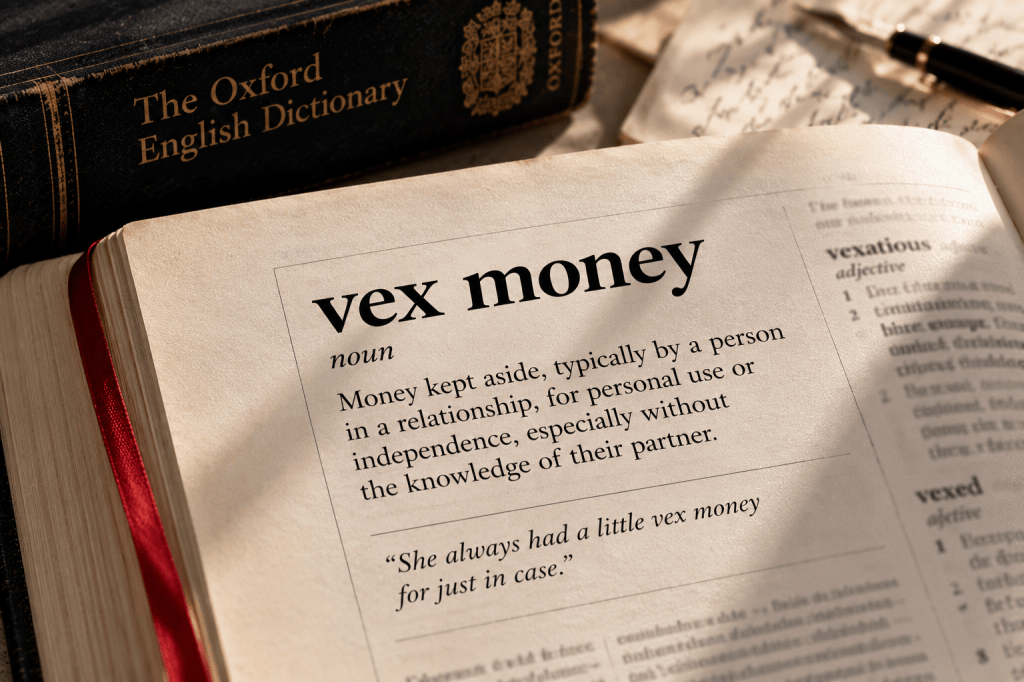
The September update extends far beyond Trinidad and Tobago, with additions from the Caribbean, Bermuda, East Africa, New Zealand, Wales and the Isle of Man. Oxford specifically highlights the jablesse from Caribbean folklore and describes the douen as a “Trinbagonian addition”. The wider Caribbean additions reported around the release include words immediately familiar to us: Canboulay, douen, hornerman, jablesse, nana, nani, peanut punch, sugar cake, to get on, Trinbagonian and vex money. (Oxford University Press)
Reading them together feels almost like reading a tiny, slightly unruly biography of us. There is history and resistance in Canboulay, folklore in douen and jablesse, family and migration in nana and nani, food in peanut punch and sugar cake, relationship drama in hornerman and a remarkably efficient combination of independence, financial planning and relationship insurance in vex money. Then there is to get on, because apparently no historical record of Trinidad and Tobago would be complete without somebody getting on bad.
I love every one of them, but Trinbagonian is the word that holds me.
The others describe pieces of our culture. Trinbagonian describes us. More beautifully still, it contains both of us. I have always been particular about saying Trinidad and Tobago because the name of this country contains two islands and neither should disappear in the telling. Trinbagonian solves that problem inside the word itself, linguistically stitching Trinidad and Tobago together every time we say who we are.
Oxford has not suddenly made that word legitimate, of course, nor has it made any of the others more authentically ours. Dictionaries do not create language in that way. People do. We make words necessary by living lives that require them. We invent them, inherit them, borrow them, bend them, sing them, argue with them, cook with them and pass them from one generation to another until their meanings become so instinctive that we forget there was ever a time when somebody had to create them.
What Oxford does is different, and to me enormously important. It records the evidence.
The Oxford English Dictionary is a historical dictionary containing more than 500,000 entries and 3.5 million quotations spanning more than 1,000 years of English. Its lexicographers continuously monitor language through corpora, social media, reading programmes and other sources, collecting evidence of how words and meanings are actually being used. (Oxford University Press)
That makes this story much bigger to me than a collection of Trinidad and Tobago words receiving some sort of British stamp of approval. We did not finally make it into the English language. We have been helping to make the English language all along.
English travelled around the world through trade, migration and histories of empire and colonisation that were often violent, but wherever the language went, the people who inherited it changed it. Languages cannot travel through human beings and remain untouched. We borrow words from one another. We alter pronunciations. We change meanings. We compress ideas. We combine languages. We invent vocabulary because the language available to us does not always contain everything required to describe the lives we are actually living.
Trinidad and Tobago has done that spectacularly. We lime. We mamaguy. We make style. We have tabanca. People can be dotish, situations can descend into bacchanal and someone can promise to arrive “just now” while communicating almost no information from which a reliable arrival time can be calculated. We can ask someone why they are getting on so and everyone involved understands that nobody is enquiring about the process of boarding transportation.
That isn’t English being damaged. That is English being alive.
Our history with the OED also did not begin on Wednesday. Caribbean English has been increasingly documented within Oxford’s work over time, and the latest update is another chapter in a much longer relationship between regional speech and the historical record of English. What I could not responsibly establish while researching this piece was a single definitive “first Trini word” ever to enter the OED. The dictionary itself has been compiled, supplemented and revised across generations, while words from the Caribbean have travelled through English for centuries. It is precisely the sort of neat historical claim that becomes tempting when writing an article and precisely the sort I would rather leave unanswered than pretend I can prove.
What we can see clearly is something more interesting: our language has been leaving footprints for generations.
That idea has been following me lately because I have spent much of this week thinking about patriotism, writing and what it means to leave a record of a place you love.
My grandmother was Welsh, and she taught me patriotism long before I understood that was what she was teaching me. Wales lived inside her through food, stories, traditions, places, memories and an unwavering pride in where she came from. Watching her taught me that patriotism is not only ceremonial. A country can become part of the way a person sees the world.
I brought that lesson home to Trinidad and Tobago. I have been writing professionally since 1996, and since starting TTChatterbox in 2014 I have spent twelve years deliberately paying attention to this country. Food. Places. People. Things. Trinidad and Tobago. I have photographed restaurants, businesses, products, buildings, events and ordinary details because something in me thought they were worth noticing. Today my photographic archive contains more than 160,000 images, alongside years of articles, interviews and stories.
For a long time I thought primarily of that body of work as journalism, writing, photography and publishing. Increasingly I understand it as a record.
Restaurants close. Buildings disappear. Products we grew up with vanish from shelves. Recipes change. Businesses pass between generations. Artists stop making things. Carnival traditions evolve. People who seem permanent to us are not. The ordinary thing everybody knows today can become the thing somebody is desperately trying to research tomorrow.
Language proves the point beautifully. If nobody records how a word is used, where it appears and what it means, reconstructing its history becomes infinitely harder. Culture cannot survive solely on the assumption that somebody will remember.
And in 2026, that has consequences that extend far beyond dictionaries and libraries because we are changing the way we discover knowledge itself.
For years, anyone publishing online learnt the language of SEO, Search Engine Optimisation. At its simplest, SEO is about making information understandable and discoverable through search engines. We learnt to think about search terms, headlines, metadata, links, authority, structure and the questions people type into Google because publishing something on the internet is not the same thing as making it findable.
Now another acronym has joined the conversation: GEO, Generative Engine Optimisation. As people increasingly ask generative AI systems questions rather than only searching through lists of links, publishers, brands and organisations are beginning to think about whether their information can be found, understood, attributed and used accurately within those new systems.
I find that development fascinating because beneath all the technological language sits an extraordinarily old idea.
Before something can be found, somebody has to record it.
SEO cannot optimise a history nobody wrote. GEO cannot help an artificial intelligence understand a culture for which reliable source material barely exists. A machine cannot instinctively know the difference between Trinidad and Tobago, Trinidadian and Trinbagonian. It cannot inherently understand why Canboulay matters, why generations of children were warned about douens, why somebody keeps vex money, what a cold peanut punch tastes like or why telling somebody they are “getting on bad” carries far more cultural information than those three words appear to contain.
For those things to be understood, there must first be evidence. Journalism. Scholarship. Dictionaries. Books. Photographs. Interviews. Archives. Websites. First-hand accounts. Reliable articles. Human beings noticing something and deciding it is important enough to record.
That is where SEO and GEO stop being merely marketing conversations for me and become something much more interesting. They are also questions about whose information is sufficiently present in the digital record to be discovered.
If Trinidad and Tobago does not document Trinidad and Tobago, the internet can only understand us through whatever fragments happen to exist.
That matters to a country, but it also matters at the smallest level. It matters to the entrepreneur whose business has existed for 30 years but whose origin story has never been published. It matters to the chef whose philosophy lives in her head but nowhere searchable. It matters to the artist whose work is photographed but never contextualised. It matters to the family business whose founders are ageing, the Carnival character whose history everybody assumes everybody knows and the neighbourhood place whose sign could disappear tomorrow.
It is one of the reasons I now see TTChatterbox differently. Every time I interview somebody, photograph a business, document a product, write the history of a place or explain some wonderfully particular piece of Trinidad and Tobago, I am not simply making content for today. I am adding another searchable, attributable record to the digital footprint of this country.
Somebody can Google it tomorrow. A researcher may find it years from now. A Trinbagonian living abroad may stumble across it. A future journalist may use it to begin another story. And increasingly, an AI system attempting to answer a question about Trinidad and Tobago may encounter the records we leave behind.
That places responsibility on those of us who publish. I don’t want our digital cultural record to consist only of disappearing Stories, trending sounds and seven-second videos created to satisfy an algorithm. Those things can be joyful and useful, but alongside them I want names, dates, photographs, histories, interviews, definitions and context. I want Trinidad and Tobago to leave an editorial footprint substantial enough that future generations do not have to guess who we were.
Perhaps that is why Wednesday’s Oxford announcement affected me so deeply. It arrived on the eve of the 50th anniversary of our Republic carrying a word for the people of that Republic, and it reminded me that identity is not only something we feel. It is something we name, document and leave evidence of.
I keep returning to that little girl with the enormous dictionary resting against her legs. I opened Oxford because I wanted its words to take me somewhere, and every unfamiliar definition felt like a tiny door into another world. I could not have known that decades later, after spending my life writing and photographing my own corner of the world, I would watch that same historical record make more room for words that sound like home.
The book seemed enormous to me then. It seems even bigger to me now, because among more than half a million entries documenting more than a thousand years of English there is more evidence of us: our folklore, our food, our history, our behaviour and, beautifully, a word for ourselves.
The English language just got more Trinbagonian, although we Trinbagonians know we have been working on that for a very long time.


