
Every few weeks a new debate ignites on social media in Trinidad and Tobago, but this time it feels louder. People are openly questioning whether influencers and content creators can be trusted. Whether their “reviews” mean anything. Whether their love for a product is genuine or simply sponsored. Whether the person behind the camera cares about the product at all.
And honestly, the conversation is overdue.
We are living in an era where the camera is the qualification. Where visibility has been confused with expertise. Where someone with a phone, a following and an idea suddenly holds the influence that once belonged to advertising agencies, media houses and brand strategists with decades of training and expertise.
Once upon a time what reached the public went through a system. Layers of research, creative development, media planning and consumer analysis. Teams studied buying behaviour. They understood demographics, psychographics and market segmentation. They knew who they were speaking to, why they were speaking to them and what message would move them from awareness to action.
Now? One person wakes up, puts on a ring light, does a skit and that becomes the entire marketing plan.
And we wonder why the public is losing trust.

This erosion of trust isn’t just happening here. China recently passed a law requiring influencers who speak on certain topics such as finance, law, healthcare, the economy, to actually hold academic qualifications in those areas. Imagine that. A country saying if your influence affects public behaviour, you need more than followers. You need facts.
It’s a global signal. Influence without education, without ethics, without accountability, is a problem.
And here at home we are asking our own versions of the same question.
What exactly qualifies someone to be a “foodie”?
A fork? A ring light? The ability to say “this bussin” or “it lash” on camera?
Food criticism is an art, a craft, a discipline. It involves understanding technique, balance, sourcing, culture, plating and palate. Yet somehow the digital world has turned “I like to eat” into a professional credential. And brands are buying into it.
But if a content creator is being paid to endorse a restaurant, do they reply to the DMs from real consumers asking follow-up questions?
Do they answer concerns about taste, portion size, service, value, ingredients, allergens?
Or do those messages quietly disappear into the abyss of their inbox?
Because that is the difference between advertising and simple product placement.
Advertising is accountable.
Product placement is convenient.
And here is the part of the conversation that Trinidad and Tobago seems ready to confront:
An advertisement has never tried to be anything other than an advertisement.
When a TV commercial crossed your screen, you knew it was an ad.
When you heard a jingle on the radio, you knew it was marketing.
When you opened the newspaper and saw a double-page spread, you knew it was paid placement.
Ads never pretended to be your friend.
They never pretended to be a casual recommendation.
They stood proudly in their identity, crafted by strategists, backed by data, built by creatives and rooted in the science of selling.
And many of those ads sold millions of dollars in products and services.
Today, however, influencers and creators are expected to sell without ever admitting they are selling. They disguise sponsored content as “just sharing.” They present paid partnerships as personal opinions. They position ads as authenticity. And then we wonder why consumers feel misled.
So does truth still matter?
Because ads never disguised who they were.
They were honest, overt, transparent and incredibly effective.
But to understand this shift properly, we need to look at the biggest brands in the world. Brands with billion-dollar budgets. Brands that shape culture.
What are Coca-Cola, Starbucks, Nike, McDonald’s and Sephora actually doing?
They are not relying on one creator with a phone.
They are using influencers strategically.
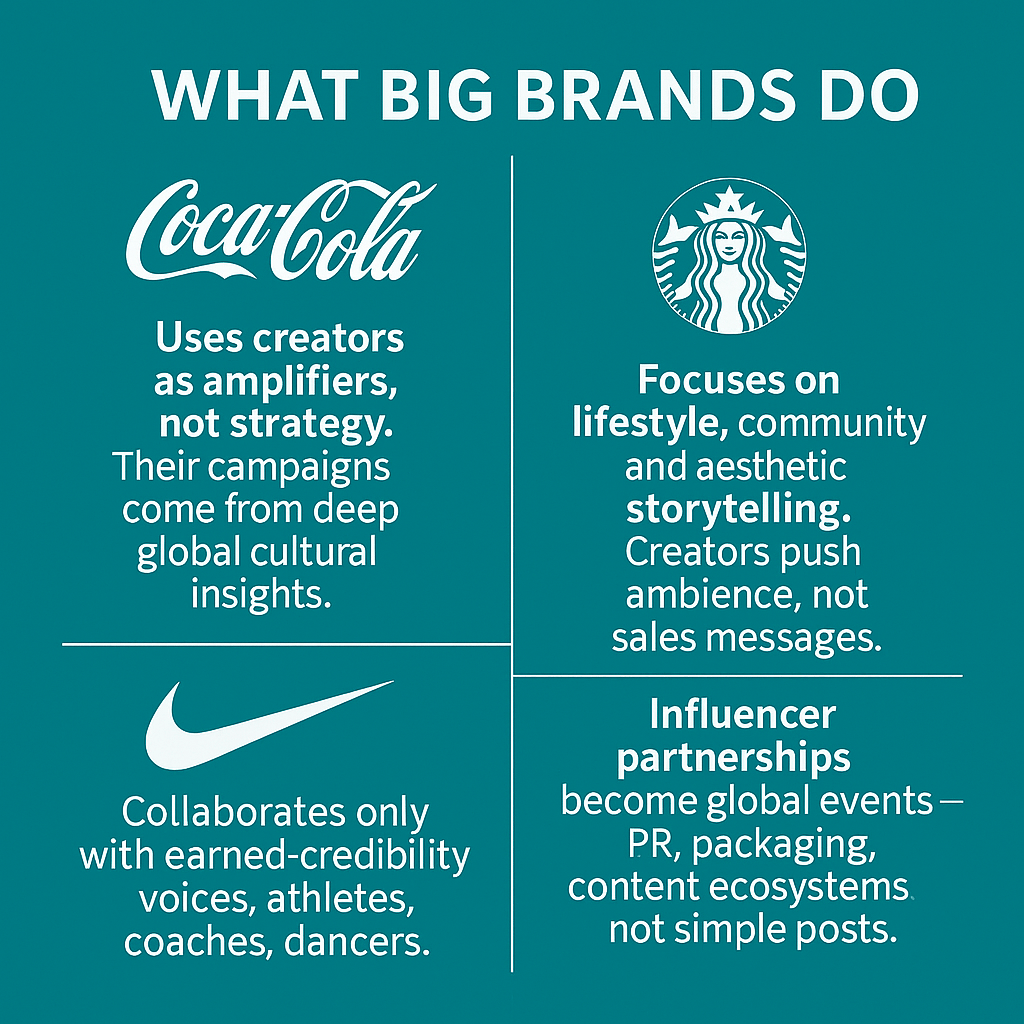
Coca-Cola partners with creators to support massive global campaigns like Coke Creations but the storytelling, behavioural insights, cultural strategy and brand narrative come from Coca-Cola itself. Influencers amplify the message. They do not create the message.
Starbucks uses influencers for community, ambience, seasonal excitement and lifestyle storytelling but their most successful content is user-generated. Starbucks controls the brand. Creators simply orbit it.
Nike collaborates with athletes, coaches, dancers and cultural figures with earned influence. Not random popularity. Their creators reflect the brand’s values, credibility and performance heritage.
McDonald’s influencer collaborations (like the Travis Scott Meal or BTS Meal) worked because they were backed by global PR, merchandising, packaging, storytelling and advertising. They weren’t influencer posts, they were cultural events.
And Sephora?
Sephora built an entire Creator Squad with creators who receive brand training, product education and ongoing development. Their influence is managed like talent. Supervised. Guided. Strategically aligned.
The biggest brands in the world are proving that influencers do not replace marketing teams. They complement them.
And what about when influencers become brand owners?
Some succeed brilliantly. Fenty Beauty, Chamberlain Coffee, Huda Beauty, Feastables. But only because they hired experts in product development, branding, operations, supply chain, R&D and marketing. Their influence opened the door. Strategy kept it open.
Others fail spectacularly such as ITEM Beauty, Prime controversies, R.E.M. Beauty struggled because hype alone cannot sustain a brand. Influence can launch a product, but only strategy can scale it.
Which brings us back to the question Trinidad and Tobago is wrestling with.
The public is not wary because creators exist. They are wary because creators have been placed in a role they were never trained for. They are expected to be the strategist, the analyst, the creative, the media planner and the salesperson. All at once. The industry has skipped the fundamentals and gone straight to “influencers will get the job done.”
But will they?
That is the question Trinidad and Tobago is trying to answer.
And the question I want to pose is simple:
Can one man or woman with a phone, a following and an idea truly sell a product?
Or have we confused visibility with influence and influence with conversion?
Because in a landscape where trust is thinning and consumers are paying attention, we may finally need to separate who creates content from who truly knows how to shape behaviour.
And maybe, just maybe, the future lies somewhere in the middle. Where creators keep their magic, marketers keep their science and brands stop expecting skits to replace strategy.
It is why platforms like TTChatterbox exist: to bring structure back into storytelling.
To blend creativity with strategy.
To highlight brands and entrepreneurs with honesty, depth and context.
To ask the questions influencers don’t ask and tell the stories ads don’t tell.
Because at the heart of it, features journalists have always told the stories behind brands.
They dig deeper.
They uncover the human journey.
They understand the craft, the discipline and the responsibility of shaping a narrative that is both truthful and compelling.
And that is exactly where TTChatterbox stands.
My 30-plus years in journalism have earned me the right and the responsibility, to tell the stories of entrepreneurs and brands with integrity, curiosity and respect.
To ask the right questions.
To pull out the insight hiding underneath the surface.
To honour the people building businesses in Trinidad and Tobago, not just the products they sell.
TTChatterbox was built long before the ring lights and the trends. It was built on research, storytelling and the belief that a well-told story is still one of the most powerful tools in marketing.
And in a world where influence is loud but trust is quiet, maybe what we need is not more noise, but more clarity.


